> ## Documentation Index
> Fetch the complete documentation index at: https://speakeasy-20cf8bdf.mintlify.site/llms.txt
> Use this file to discover all available pages before exploring further.
# NextAuth.js
> Learn how to track lead conversion events with NextAuth.js and Dub
When it comes to conversion tracking, a `lead` event happens when a user performs an action that indicates interest in your product or service. This could be anything from:
* Signing up for an account
* Adding a product to cart
* Joining a mailing list
 In this guide, we will be focusing on tracking new user sign-ups for a SaaS application that uses NextAuth.js for user authentication.
## Prerequisites
Before you get started, make sure you follow the [Dub Conversions quickstart guide](/conversions/quickstart) to get Dub Conversions set up for your links:
1. [Enable conversion tracking for your links](/conversions/quickstart#step-1-enable-conversion-tracking-for-your-links)
2. [Install the @dub/analytics client-side SDK](/sdks/client-side/introduction)
3. [Install the Dub server-side SDK](/conversions/quickstart#step-3-install-the-dub-server-side-sdk)
## Configure NextAuth.js Options
Then, set up your NextAuth.js configuration options to track lead conversion events using the `dub` TypeScript SDK.
Here's how it works in a nutshell:
1. Use NextAuth's [`signIn` event](https://next-auth.js.org/configuration/events#signin) to detect when there's a new sign up.
2. If the user is a new sign up, check if the `dub_id` cookie is present.
3. If the `dub_id` cookie is present, send a lead event to Dub using `dub.track.lead`
4. Delete the `dub_id` cookie.
Under the hood, Dub records the user as a customer and associates them with the click event that they came from. The user's unique ID is now the source of truth for all future events – hence why we don't need the `dub_id` cookie anymore.
```typescript App Router theme={null}
// app/api/auth/[...nextauth]/options.ts
import type { NextAuthOptions } from "next-auth";
import { cookies } from "next/headers";
import { dub } from "@/lib/dub";
export const authOptions: NextAuthOptions = {
...otherAuthOptions, // your other NextAuth options
events: {
async signIn(message) {
// if it's a new sign up
if (message.isNewUser) {
// check if dub_id cookie is present
const dub_id = cookies().get("dub_id")?.value;
if (dub_id) {
// send lead event to Dub
await dub.track.lead({
clickId: dub_id,
eventName: "Sign Up",
externalId: user.id,
customerName: user.name,
customerEmail: user.email,
customerAvatar: user.image,
});
// delete the dub_id cookie
cookies().set("dub_id", "", {
expires: new Date(0),
});
}
}
},
},
};
```
```typescript Pages Router theme={null}
// pages/api/auth/[...nextauth]/options.ts
import type { NextApiRequest } from "next";
import type { NextAuthOptions } from "next-auth";
import { dub } from "@/lib/dub";
export const getOptions = (req: NextApiRequest): NextAuthOptions => ({
...otherAuthOptions, // your other NextAuth options
events: {
async signIn(message) {
// if it's a new sign up
if (message.isNewUser) {
// check if dub_id cookie is present
const { dub_id } = req.cookies;
if (dub_id) {
// send lead event to Dub
await dub.track.lead({
clickId: dub_id,
eventName: "Sign Up",
externalId: user.id,
customerName: user.name,
customerEmail: user.email,
customerAvatar: user.image,
});
}
}
},
},
});
```
Here's the full list of attributes you can pass when sending a lead event:
| Property | Required | Description |
| :--------------- | :------- | :----------------------------------------------------------------------------------------------------------------------- |
| `clickId` | **Yes** | The unique `dub_id` parameter that the lead conversion event is attributed to. |
| `eventName` | **Yes** | The name of the event. Example: "Sign up". |
| `externalId` | **Yes** | The unique ID of the customer in your system. Will be used to identify and attribute all future events to this customer. |
| `customerEmail` | No | The email address of the customer. If not passed, a random email address will be generated. |
| `customerName` | No | The name of the customer. If not passed, a random name will be generated (e.g. "Big Red Caribou"). |
| `customerAvatar` | No | The avatar URL of the customer. If not passed, a random avatar URL will be generated. |
## Create a NextAuth.js Route Handler
Finally, import the `authOptions` variable you created earlier and use `NextAuth` to create a handler for your NextAuth.js routes.
```typescript App Router theme={null}
// app/api/auth/[...nextauth]/index.ts
import { authOptions } from "./options";
import NextAuth from "next-auth";
const handler = NextAuth(authOptions);
export { handler as GET, handler as POST };
```
```typescript Pages Router theme={null}
// pages/api/auth/[...nextauth]/index.ts
import type { NextApiRequest, NextApiResponse } from "next";
import NextAuth from "next-auth";
import { getOptions } from "./options";
const handler = (req: NextApiRequest, res: NextApiResponse) =>
NextAuth(req, res, getOptions(req));
export default handler;
```
## View your conversions
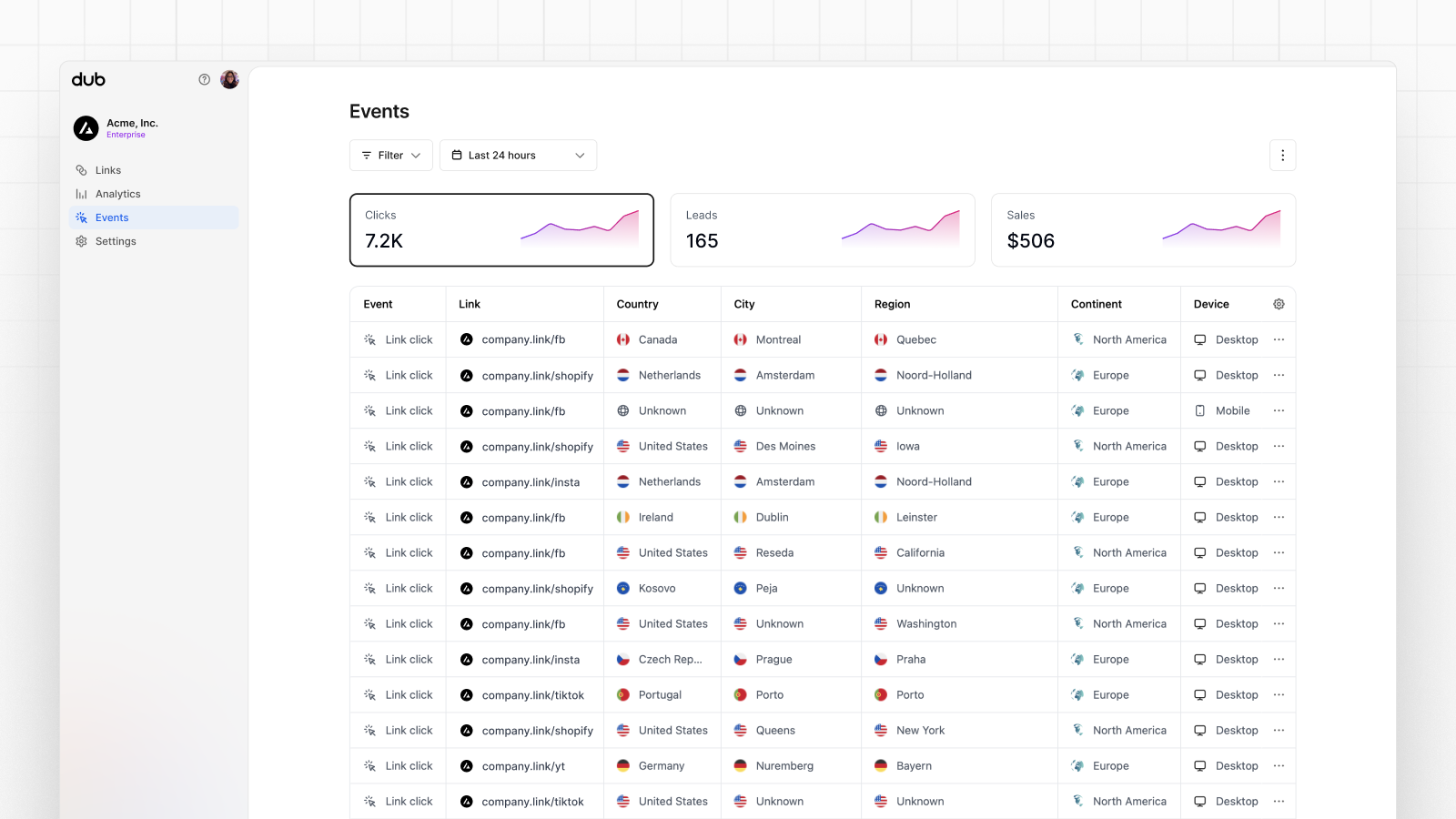
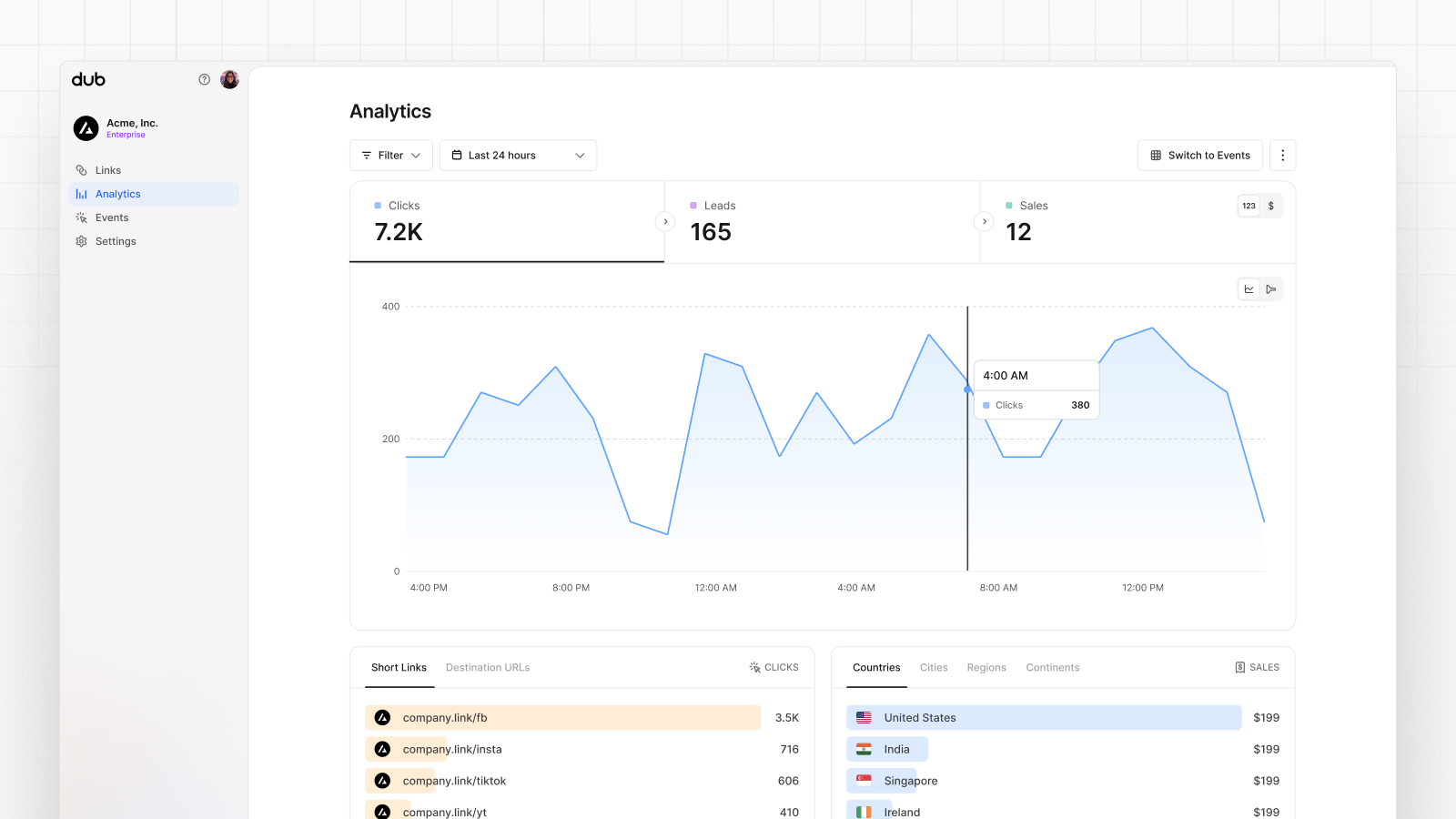
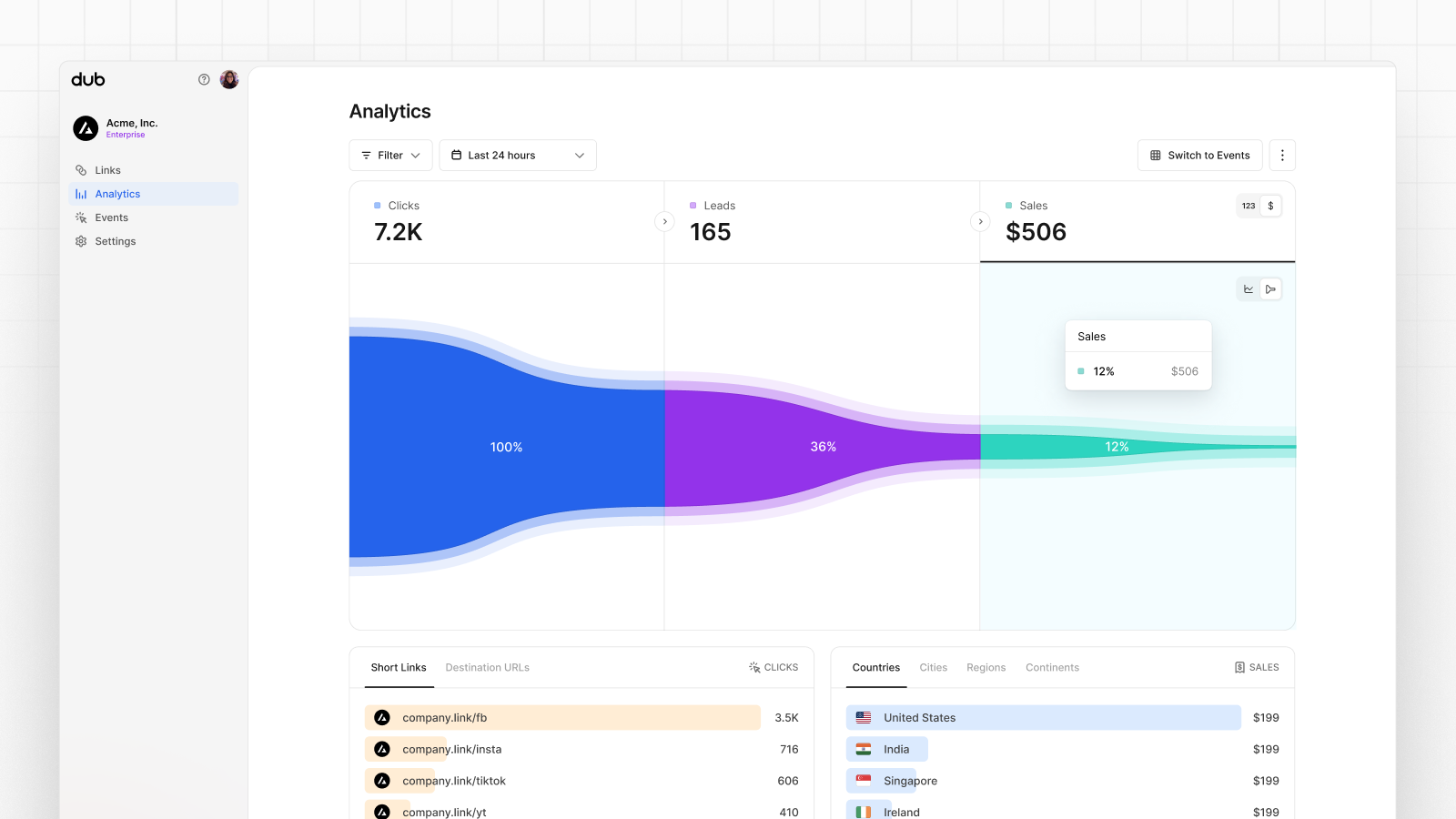
Once you've enabled conversion tracking for your links, all your tracked conversions will show up on your [Analytics dashboard](https://app.dub.co/analytics). We provide 3 different views to help you understand your conversions:
* **Time-series**: A [time-series view](https://dub.co/help/article/dub-analytics#1-time-series-analytics-chart) of the number clicks, leads and sales.
In this guide, we will be focusing on tracking new user sign-ups for a SaaS application that uses NextAuth.js for user authentication.
## Prerequisites
Before you get started, make sure you follow the [Dub Conversions quickstart guide](/conversions/quickstart) to get Dub Conversions set up for your links:
1. [Enable conversion tracking for your links](/conversions/quickstart#step-1-enable-conversion-tracking-for-your-links)
2. [Install the @dub/analytics client-side SDK](/sdks/client-side/introduction)
3. [Install the Dub server-side SDK](/conversions/quickstart#step-3-install-the-dub-server-side-sdk)
## Configure NextAuth.js Options
Then, set up your NextAuth.js configuration options to track lead conversion events using the `dub` TypeScript SDK.
Here's how it works in a nutshell:
1. Use NextAuth's [`signIn` event](https://next-auth.js.org/configuration/events#signin) to detect when there's a new sign up.
2. If the user is a new sign up, check if the `dub_id` cookie is present.
3. If the `dub_id` cookie is present, send a lead event to Dub using `dub.track.lead`
4. Delete the `dub_id` cookie.
Under the hood, Dub records the user as a customer and associates them with the click event that they came from. The user's unique ID is now the source of truth for all future events – hence why we don't need the `dub_id` cookie anymore.
```typescript App Router theme={null}
// app/api/auth/[...nextauth]/options.ts
import type { NextAuthOptions } from "next-auth";
import { cookies } from "next/headers";
import { dub } from "@/lib/dub";
export const authOptions: NextAuthOptions = {
...otherAuthOptions, // your other NextAuth options
events: {
async signIn(message) {
// if it's a new sign up
if (message.isNewUser) {
// check if dub_id cookie is present
const dub_id = cookies().get("dub_id")?.value;
if (dub_id) {
// send lead event to Dub
await dub.track.lead({
clickId: dub_id,
eventName: "Sign Up",
externalId: user.id,
customerName: user.name,
customerEmail: user.email,
customerAvatar: user.image,
});
// delete the dub_id cookie
cookies().set("dub_id", "", {
expires: new Date(0),
});
}
}
},
},
};
```
```typescript Pages Router theme={null}
// pages/api/auth/[...nextauth]/options.ts
import type { NextApiRequest } from "next";
import type { NextAuthOptions } from "next-auth";
import { dub } from "@/lib/dub";
export const getOptions = (req: NextApiRequest): NextAuthOptions => ({
...otherAuthOptions, // your other NextAuth options
events: {
async signIn(message) {
// if it's a new sign up
if (message.isNewUser) {
// check if dub_id cookie is present
const { dub_id } = req.cookies;
if (dub_id) {
// send lead event to Dub
await dub.track.lead({
clickId: dub_id,
eventName: "Sign Up",
externalId: user.id,
customerName: user.name,
customerEmail: user.email,
customerAvatar: user.image,
});
}
}
},
},
});
```
Here's the full list of attributes you can pass when sending a lead event:
| Property | Required | Description |
| :--------------- | :------- | :----------------------------------------------------------------------------------------------------------------------- |
| `clickId` | **Yes** | The unique `dub_id` parameter that the lead conversion event is attributed to. |
| `eventName` | **Yes** | The name of the event. Example: "Sign up". |
| `externalId` | **Yes** | The unique ID of the customer in your system. Will be used to identify and attribute all future events to this customer. |
| `customerEmail` | No | The email address of the customer. If not passed, a random email address will be generated. |
| `customerName` | No | The name of the customer. If not passed, a random name will be generated (e.g. "Big Red Caribou"). |
| `customerAvatar` | No | The avatar URL of the customer. If not passed, a random avatar URL will be generated. |
## Create a NextAuth.js Route Handler
Finally, import the `authOptions` variable you created earlier and use `NextAuth` to create a handler for your NextAuth.js routes.
```typescript App Router theme={null}
// app/api/auth/[...nextauth]/index.ts
import { authOptions } from "./options";
import NextAuth from "next-auth";
const handler = NextAuth(authOptions);
export { handler as GET, handler as POST };
```
```typescript Pages Router theme={null}
// pages/api/auth/[...nextauth]/index.ts
import type { NextApiRequest, NextApiResponse } from "next";
import NextAuth from "next-auth";
import { getOptions } from "./options";
const handler = (req: NextApiRequest, res: NextApiResponse) =>
NextAuth(req, res, getOptions(req));
export default handler;
```
## View your conversions
Once you've enabled conversion tracking for your links, all your tracked conversions will show up on your [Analytics dashboard](https://app.dub.co/analytics). We provide 3 different views to help you understand your conversions:
* **Time-series**: A [time-series view](https://dub.co/help/article/dub-analytics#1-time-series-analytics-chart) of the number clicks, leads and sales.
 * **Funnel chart**: A funnel chart view visualizing the conversion & dropoff rates across the different steps in the conversion funnel (clicks → leads → sales).
 * **Real-time events stream**: A [real-time events stream](https://dub.co/help/article/real-time-events-stream) of every single conversion event that occurs across all your links in your workspace.